We Dreamed a Dream
A downloadable playable ritual
What we heard
Once, we read somewhere that, across the wide spectrum of earth's civilizations, a single kind of game has been played, in many ways and by many peoples, but always with the same intention: to guess someone's dream.
One of us would recall a dream that was particularly potent or significant, the kind of dream that we knew, deep, deep down, had a meaning that we needed to share. At night, we sat around, perhaps by a fire, for an hour or a few, and the rest of us asked the one of us who was the dreamer such simple questions as "did we dream of an eagle?" or "Did the eagle speak?" or "Was the speaking eagle our grandmother?" or "Did your grandmother, the eagle, speak to us of revenge?"
In this way, a dream that traveled to us through the narrow aperture of an individual sleeper became a common narrative. We dreamed a dream of ourselves and we became a we.
Then some of us lost that power.
Then some of us played to get it back.
How we prepared to play
We gathered in a group of no fewer than three and, while there was no upper limit, we found nine or ten of us to be challenging. It seemed the best number was six.
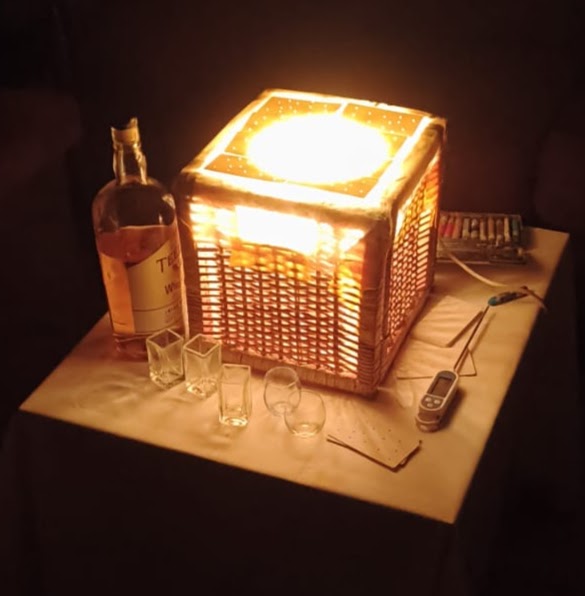
We collected many blank cards or pieces of heavy paper of the same shape (or different shapes) and poked holes so they became like stars in the night sky. If we could find a way, we placed them on top of a source of light in a dark room, so the only illumination shone up through the stars, so the light and shadow played out on our hands and faces. The cards glowed warmly as we sat together. Other times, we simply laid the cards on a table. We laid the cards in a pattern, touching.
We had thick pens or crayons nearby that would leave opaque marks on the cards.
We took care to create a good atmosphere: dark, cosy, meaningful. Sometimes we lit candles. We sat in a circle around the cards and played music (we especially liked Harold Budd's EP The Pavilion of Dreams.
We knew that each game would take us the better part of an hour, and that we would find it enchanting and silly, seductive and spooky, whimsical and weird, just like us.
We knew, above all, that this game could never, ever, ever be played when the sun was awake, at risk of causing us nightmares. It was important.
How we played
The one of us who was the dreamer
One of us identified as the dreamer. That one of us recalled a dream that was not just a dream, but a powerful dream, a dream we knew was meant to be shared.
That one of us began the game by saying: "We dreamed a dream...." and told us one (and only one) very brief but beguiling feature of our dream "...that our cat spoke to us about love" or "...that we had to save our mother from the fire" or "...that there was an intelligent hail storm."
That one of us who shared the dream took one of the cards with the holes that looked like stars and used the thick crayon or pen to draw a line connecting several of them so that a new constellation appeared in the night sky. Sometimes that constellation literally pictured what that one of us who was the dreamer described. Other times it was more abstract. This helped us remember. They placed the card with the others.
Those ones of us who were not the dreamer, who guessed
The one of us to the dreamers' left (always to the left, never to the right) now repeated what the dreamer said, as closely as they could, starting with "We dreamed a dream..." and then, after repeating all they could recall, asked a question: "Was the hail angry?" or "was the cat's heart broken?" or "did your mother start the fire?"
The one of us who was the dreamer was not allowed to speak any longer, for the rest of the game, but could make gestures like nodding or shaking the head.
If the one of us who was the dreamer affirmed the guess, the one of us who was the dreamer offered the one of us who was the guesser one of the blank star cards, and the one of us who was the guesser connected several stars to represent our new knowledge and replaced the card with the others, expanding the night sky.
If the one of us who was the guesser didn't guess something that the one of us who was the dreamer affirmed, the turn was over and we did not contribute to the night sky that time.
Our turn was over. Our next turn began with the one of us to the left of the last guesser. Always to the left.
It continued like this, and each of us in turn repeated "we dreamed a dream..." then repeated every part of the story, as best as we could remember, followed by a new question. It went something like this: "We dreamed a dream about an intelligent hail storm. The hail was angry. We were trying to calm it. Everyone was relying on us. Did we have the power we needed?"
We tried our best, but we often forgot things we'd heard, but that was ok: we would remember them in the future. Every time our guess was affirmed by the one of us who was the dreamer, we added a new constellation to the night sky.
We always used the pronoun we. We always used the pronoun we.
The one of us who was the dreamer decided
When it was again the turn of the one of us who was the dreamer, that one decided if we had learned enough about the dream to begin interpreting it. Usually this happened when we had 7-10 cards in the night sky, but sometimes it took longer. If that one of us who was the dreamer felt like we needed more time, we kept playing another round, and again and again until that one of us who was the dreamer brought the guessing to a close. We deeply trusted that one of us who was the dreamer, they did not have to explain or justify that choice for us, we knew their choice was in our best interests, and time yes time began to hover and yawn, to shimmer and chuckle.
We took our time to dream together. But when, after maybe five rounds or a hundred rounds, that one of us who was the dreamer told us it was time to interpret the dream, we paused for a few minutes and in silence asked ourselves: what did our dream mean?
After a moment, the one of us who was the dreamer invited us to share shared our interpretations of our dream, starting with the one of us who was to the left of the one of us who was the dreamer and going one-by-one, always to the left. Sometimes our meanings were confluent and sometimes they were contradictory. Sometimes they were sill and sometimes profound.
After we had all shared our meanings, the that one of us who was the dreamer offered some final words, not explaining the dream itself, but about how the our interpretations cast new light on the dream.
What did we dream?
We often wanted to know what the "real" dream was, but we sweetly resisted the temptation. The new, common dream had become something else no less real. Maybe even more real. This was never a game about guessing the "true meaning" of the dream. It was always about sharing and changing a dream together.
Sometimes that's how things ended, and we went off into the night alone or in pairs or in groups, to dream again. Sometimes we played again, and another among us was the dreamer. Sometimes we discovered this game was not enough and we proposed new patterns: "the next time, the one of us who is the dreamer should..." or "from now on, those of us who are not the dreamer must..."
No rule ever survives a true encounter with a dream.
Sometimes we played the dream game many times, late into the night. Sometimes once was enough.
That was how we dreamed a dream.
Leave a comment
Log in with itch.io to leave a comment.